

5 Healthcare Tech Trends for 2021

5 Healthcare Tech Trends for 2021

Though healthcare technology such as artificial intelligence and machine language have become more prominent in the medical scene organically over the years, there is no denying that the COVID-19 pandemic drastically sped up innovation. Overall, COVID-19 was an exceptional unprecedented disruption within all areas of the healthcare industry and pushed the reshaping of healthcare technology in varying ways to deal with the pandemic effectively. 

Now, with 2020 coming to an end, the fast-acting healthcare technology efforts that were conducted throughout the year will play a large role in the types of tech trends 2021 will feature. To give you some more insight on what those may entail and where healthcare as a whole is heading, below are five technologies that will likely surface throughout the upcoming year.   

  1. Robotics and Machine Learning

Because of the events that occurred in 2020, it means robotics and machine learning are things to look forward to in 2021. Even before the pandemic, every industry has been using its best efforts to optimize processes in such a way that minimizes human contact. The difference is the strive to make it happen faster is higher now. For years, robotic technologies have been used for surgical assistance, and healthcare technology like Chatbots are assisting physicians when it comes to medical advice. Now with new innovations on the rise, hospitals leveraging it in the near future is something to expect to improve patient care quality. 

  • Artificial Intelligence 

Artificial intelligence is a rapidly growing industry in healthcare and is predicted to grow as much as 40% more in 2021. In short, artificial intelligence is not a new term in healthcare, but it is something that has and continues to revolutionize the medical culture. There are AI algorithms out there that can manage medical records, design treatment plans, and even develop drugs faster than a human professional could. To date, there are already artificial intelligence designs like Atomwise that use supercomputers to discover therapies from molecular structure databases. More recently, Google’s DeepMind developed an AI that outperforms all human radiologists in identifying breast cancer. 

Now, AIs like BlueDot are being used to fight against COVID-19, which raises the 2021 trend of AIs being able to alert pandemic detection, create vaccines, and perform facial recognition even when wearing a mask. What is even more intriguing is that these developments are just scratching the surface of the opportunities to come. 

  • Augmented and Virtual Reality in Healthcare 

Virtual and augmented reality are both vital technologies that offer enhanced quality of telehealth. With COVID-19, it became more sought out because it was an outlet for providers and patients to continue their visits and medical students to stay educated with simulations. Furthermore, AR and VR technology are showing promising signs of being able to support stroke victims to overcome motor deficiencies and regain control than in a typical hospital setting. 

The reason is that simulated environments can deliver more flexible, tailored physical therapy sessions than real life can offer. Plus, augmented reality can give providers real-time access to data using these 3D spaces that they can use to benefit their procedures. Having access to all the information available through AR, VR, and other emerging technologies while staying grounded in actual procedures is why this will likely skyrocket more throughout 2021. 

  •  The Internet of Medical Things (IoMT)

The Internet of Things (IoT) is defined in a few different ways. For instance, some consider it to be completely machine-to-machine communication, while others see it as the interaction of smart devices with the internet. Whatever you think of it as, the underlying goal is clear: to enhance communication systems to promote continuous real-time flows of information. In healthcare, various devices and mobile apps are able to track and prevent chronic illnesses. With innovations and combining loT development with other telemedicine and telehealth technologies, it surfaced a new tool, and that is The Internet of Medical Things (loMT). 

The new approach includes things like wearables, EKG/ECG monitors, and other common medical measurements like glucose levels, blood pressure readings, and skin temperature. However, there are still some challenges that this new technology concept faces. One of which is getting it to a point where the devices will provide effective and consistent communication over numerous medical devices. Connectivity is another struggle as well. Regardless, the push to remediate is pedestaled, and new changes are likely to arise in 2021, making the loT industry net worth of $6.2 trillion by the year 2025 a plausible outcome. 

  • Blockchain Implementation

Blockchain technology has already vastly improved the healthcare industry and will undoubtedly continue to do so in years to come. Digital ledgers allow healthcare providers to distribute records to patients in a secure fashion, and with more upgrades to the technology, blockchain will become a solid security shield. For example, the blockchain peer to peer systems allows for large numbers of users to access a shared ledger securely, and there is no need for a basis of trust between any two parties. As healthcare technology advances, the need for security, portability, and accessibility will be fulfilled using blockchain, alongside the other 2021 tech trends like loMT and cloud computing. 

Fun fact: IBM Watson Health introduced its blockchain technology called Digital Health Pass on October 13, 2020. This allows professionals to check the health status of their employees privately.

Conclusion – Welcome to A More Patient-Centered Era 

As you can see, the tech trends 2021 will likely illuminate are quite impressive. Though much of what has occurred to date was to improve the safety of society and reduce the risk of an outbreak occurring again in the future, it’s hard to ignore that these developments also influenced more patient-centered experiences. For decades, there has been a strive amongst entrepreneurs, doctors, and leading activists to reform the healthcare system to become more patient-centered. The idea was that machine language, artificial intelligence, and other implemented healthcare technology would help make that happen. However, what ended up pushing that blueprint idea to become a reality was COVID-19. 

Of course, these tech trends 2021 has in store are integrated to streamline processes and improve the safety and wellbeing of the providers as well. But overall, the shift to patient-centered has now become forefronted, and it will be interesting to see how future technologies will manifest beyond 2021 with this new angle. 

Resources 

https://www.fiercehealthcare.com/tech/7-predictions-for-how-technology-will-shape-healthcare-2021

https://www.techrepublic.com/article/7-predictions-for-how-technology-will-shape-healthcare-in-2021/

https://thenextweb.com/world/2020/11/25/7-digital-health-trends-that-will-dominate-the-globe-in-2021/

https://www.entrepreneur.com/article/361311
https://www.beckershospitalreview.com/healthcare-information-technology/10-emerging-trends-in-health-it-for-2021.html

https://healthmanagement.org/c/healthmanagement/issuearticle/the-future-of-augmented-reality-in-healthcare#:~:text=Augmented%20reality%20is%20used%20in,experience%20for%20users%20and%20developers

Strategy Formulation Process – Part 1

Strategy Formulation Process:

In my travels as an IBM consultant, I saw and witnessed a lot about how “strategy” is discussed or how it is applied at various companies. Most times, there is at least a playbook on how strategy is developed but more times than not, strategy formulation can be misunderstood or wrongfully applied.

There are many schools of thought on strategy formulation. Everyone knows Porter’s five forces from business school and I am sure we have all seen enough SWOT charts to last a lifetime. What I have found is most essential comes down to a few basics that should begin at the highest levels of the company’s leadership team.

Step 1. Know who you are; play to your strengths. How many of us have taken Myers Briggs or some other personality test? The main point of these tests is to show you what are character strengths. They teach you (mostly) to focus on your strengths. In business your organization will fall into one of the three categories below (i.e. strengths).

  • Does your company rely on customer relationships to drive a significant amount of business? Meaning your company values and receives feedback from customers on the importance of exceptional customer service (i.e. Customer Intimacy). Companies in this category would include St. Regis, Nordstrom, Jet Blue and HSBC.
  • The next category is Operational Efficiency. This is a term that can be overused or misunderstood, just like the common definition of Cloud. Essentially, does your company focus on having their products or services available quickly and for the lowest cost. Most manufacturing companies fit into this category. Companies in this space are Wal-mart, Southwest Airlines and FedEx.
  • The last category is Product Leadership. The product or service is the only thing that matters for your company and they will spare no expense on ensuring the product stands out above any other. Typically, a consumer will be willing to pay higher prices if they know they are receiving a quality product. One of the best examples here is of course Apple. The design and ease of use of their products are at the center of everything they release. Product Leadership can also be the recognized in Mercedes, BMW and Nike.

Once you determine your strengths, ensure your leadership team agrees as well. Nothing kills strategy quicker than if the head of one business unit believes the company is Operationally Efficient rather than all the other units driving towards Customer Intimacy.

Also, recognize the difference between what is said inside the walls of your company versus what is marketed outside your company. Meaning, every company will tell you their focus is on the customer, which could confuse some inside the company if they hear messages that the company’s strategy is Product Leadership.

Step 2. A Clear Mission and Vision.

Does your company have a clear mission and vision statement? A mission statement tells people why you exist, what is the purpose for having a business and having people work for the company. A vision statement will describe where the company is heading.

Sometimes, the mission and vision can be combined. I have seen this to be an art form at some companies. In any case, a company should at least know why it exists and where it is heading.

Some good examples of mission and vision statements are below;

Nordstrom

In store or online, wherever new opportunities arise, Nordstrom works relentlessly to give customers the most compelling shopping experience possible. The one constant? John W. Nordstrom’s founding philosophy: offer the customer the best possible service, selection, quality and value.

Nike

“To bring inspiration and innovation to every athlete* in the world.”

Honest Tea

Honest Tea seeks to create and promote great-tasting, healthier, organic beverages. We strive to grow our business with the same honesty and integrity we use to craft our products, with sustainability and great taste for all.

Hormel Foods

“Building upon our heritage of innovation and quality, together we will elevate the everyday experience by making Hormel Foods the favorite part of any eating occasion.”

Step 3. Now start talking Strategy

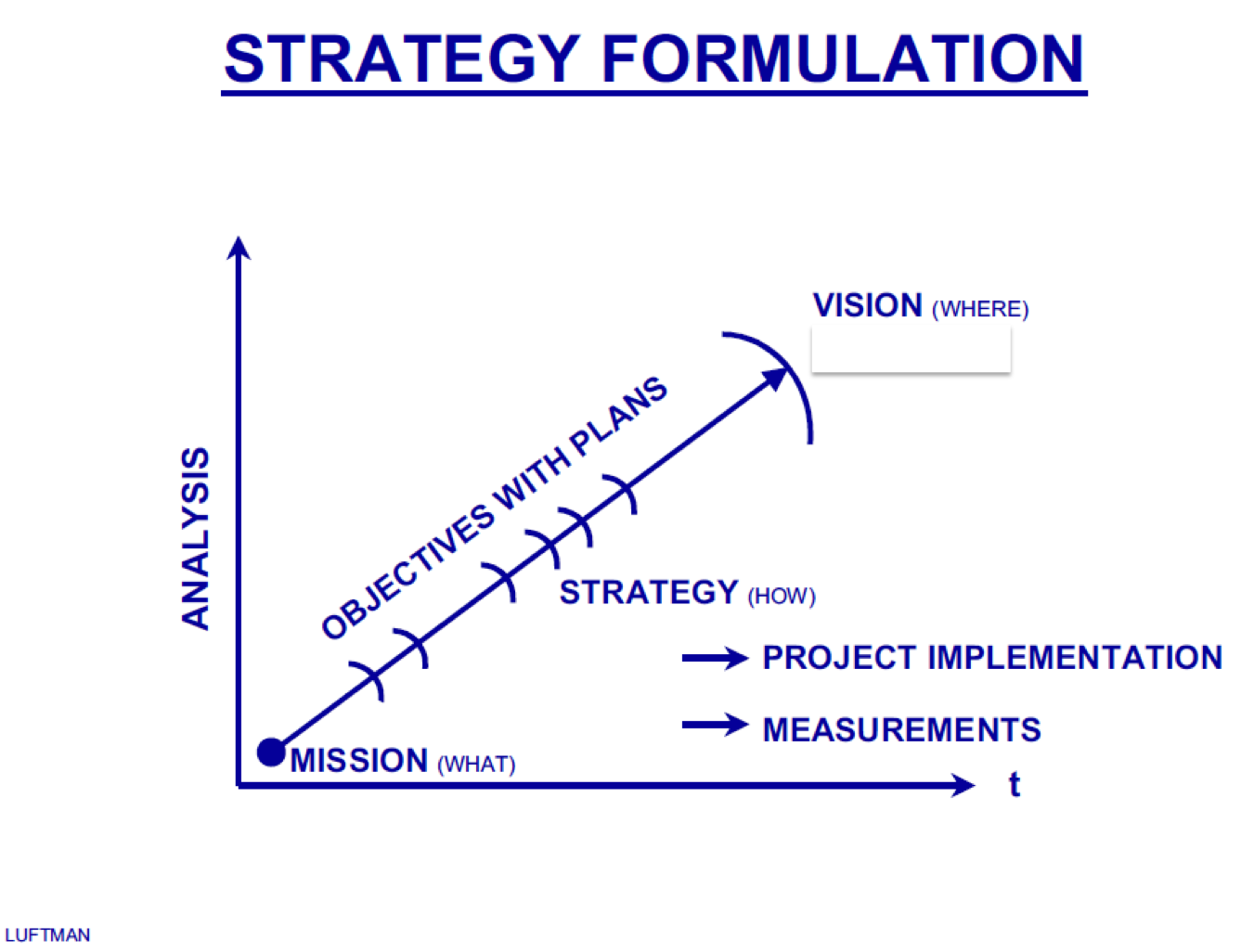
With steps 1 and 2 accomplished, you have now laid the groundwork for initial discussions on strategy within your company. I am particularly fond of J. Luftman’s simplistic graph to help begin strategy discussions.

strategy formulation

As pictured above, strategy can begin simply by asking “How are we going to achieve our goals” towards our vision as a company.

I also appreciate having Project Implementation and Measurements as part of the initial strategy discussion. With projects, at a company level, what % of projects is aligned with your strategy? Meaning are you just implementing projects that keep the lights on or are there a good percent of your projects that focus on your company’s strengths?

Regarding measurements, do you have any quantifiable means to ensure you are hitting your company’s goals (i.e. marketshare, revenue by customer segment, benchmarks, geography penetration)? I also like the quote by Tom Peters “What gets measured gets done”.

Step 4. Agree on the Strategy Horizon

It’s very easy for some to get caught up with a strategy process. Thousands of hours and dollars are devoted to off-site meetings, PowerPoint’s and resources trying to align a company’s strategy. One key point is that the senior team agree on the strategy horizon, meaning how long to look out and develop some strategy goals. Usually three to five years is a good initial start.

Typically, there should at least by one annual review of the strategy to measure and validate the strategy is on track. I have seen some companies tweak their vision statements a bit during this time but just like personal finance or your health, a yearly checkpoint is minimum.

Be careful not to go too far out on strategy. I have seen companies that have ten-year strategic plans but struggle to hit their yearly goals. It comes down to execution and focus and if you are having challenges meeting short-term goals, longer-term goals will be even more difficult.

In closing, decide what fits best for your company. Having respectful and challenging conversations on if the company has the right resources to accomplish the goals within the desired time frame is a must. It may not be realistic to grow revenue 25% in the next 3 years if the resources (both human and capital) are not ready in the pipeline to achieve the goal.

Like Myers Briggs, focus on what you do well and make strategy work for you.

In Part 2, I will go over a little more in depth of how to achieve all this within your organization and what a yearly strategy update would look like.

IT Architecture Principles and Frank Lloyd Wright

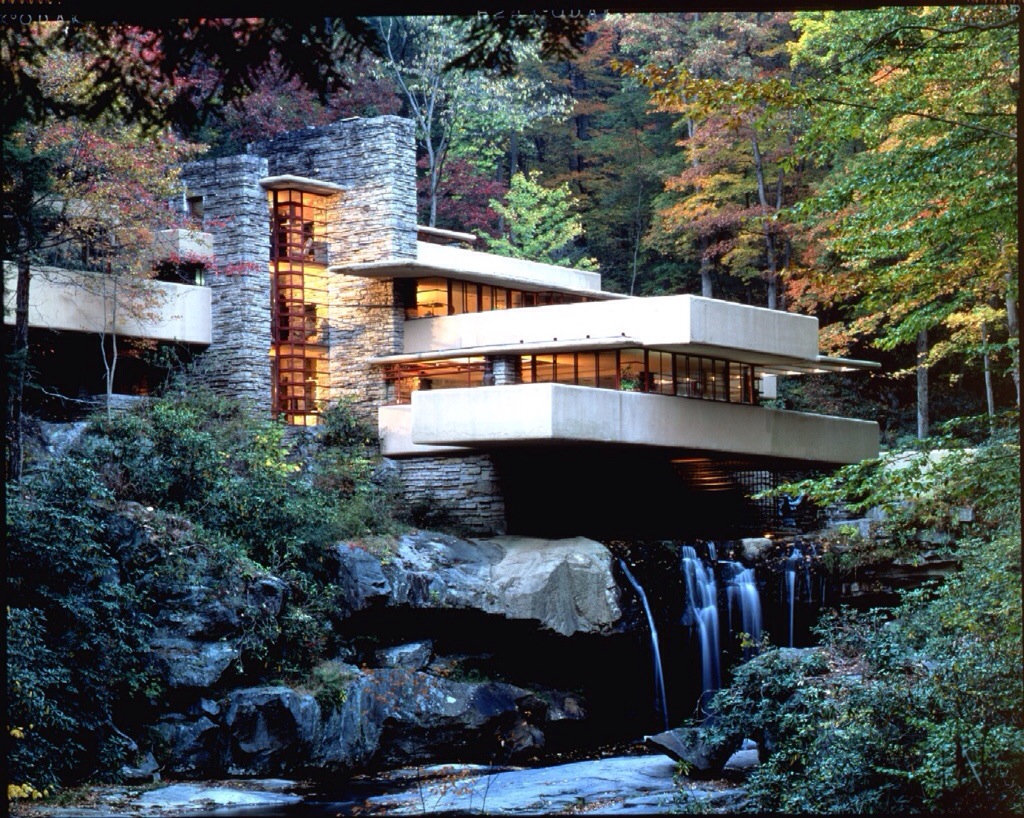
I’ve always admired Frank Lloyd Wright. I don’t know why because as an aspiring rock guitarist as a teenager, architecture was the last thing that was on my mind. However, once I saw a picture of “Falling Water”, I was instantly taken by it’s beauty and design. Maybe it was a similar pursuit in terms of being an artist that I found appealing…that is, simplicity is the ultimate form of sophistication. Listening to Barber’s Adagio for Strings, I always marveled at how Barber’s simple melody line could have a far greater aural resonance than a Bach concerto or sound as intricate as any one of Yngwie’s songs.

Falling Water has that same effect on me and as I have traveled in my professional pursuits, it has more relevance to me now in a completely different arena. With IBM, I was fortunate to work with so many great people and always have a pulse on what customers were doing with technologies and with technology frameworks. I first came across Enterprise Architecture (EA) in 2011 and I was instantly drawn to it. I was watching clients transform their whole IT department to fully embrace EA and reap it’s benefits.I read Jeanne Ross’ “Enterprise Architecture as Strategy” book over and over again and began applying EA concepts into my consulting engagements whenever possible.

As I transitioned out of IBM, I was lucky enough to land a role leading an IT architecture team and my boss had one initial directive for me; to draft a set of architecture principals for our company to use in all of our technology decisions. The choice to use EA was an easy one and our team produced, what I thought, was a great document around the primary EA domains of Business, Technology & Information architecture. When it came time to share our work, the picture of Falling Water was all I could think about to have on the cover. People would often try to wonder how this was connected to IT EA and I would share the following definitions from Wikipedia;

Architecture – Architecture has to do with planning, designing and constructing form, space and ambiance to reflect functional, technical, social, environmental and aesthetic considerations. It requires the creative manipulation and coordination of materials and technology, and of light and shadow. Often, conflicting requirements must be resolved. The practice of Architecture also encompasses the pragmatic aspects of realizing buildings and structures, including scheduling, cost estimation and construction administration. Documentation produced by architects, typically drawings, plans and technical specifications, defines the structure and/or behavior of a building or other kind of system that is to be or has been constructed. “http://en.wikipedia.org/wiki/Architecture”

Enterprise Architecture – “a well-defined practice for conducting enterprise analysis, design, planning, and implementation, using a holistic approach at all times, for the successful development and execution of strategy. Enterprise architecture applies architecture principles and practices to guide organizations through the business, information, process, and technology changes necessary to execute their strategies. These practices utilize the various aspects of an enterprise to identify, motivate, and achieve these changes.”[1]

Both definitions talk about planning, design, form, function, etc..When you look at Falling Water, you see how brilliantly Mr. Wright utilized nature to carve out this remarkable house and the strategies he used to build a house over a waterfall. When you look at a  well crafted business strategy and you utilize EA as a framework, you find yourself tackling similar issues as Mr. Wright encountered constructing Falling Water, well, minus the water. While crafting an EA strategy can make you feel like you are working underwater at times, if you have a sound architecture team and set of principals, form follows function. Hopefully you will derive the benefits of the design for many decades to come.

20140616-173714-63434019.jpg

Bobby McFerrin plays… the audience!

Bobby McFerrin showing the power of music that is ingrained in us. This video reminded me of when I was in Turkey on an International Colloquium with Emory. After a grueling day at KOC University, hearing a variety of speakers talk to us about the Turkish business environment, my fellow grad students embarked to downtown Istanbul for some relaxation. Nothing says relaxation to grad students than finding some good local spirits. As such, one of my fellow classmates (Greg) and I stumbled upon a live rock – n- roll club. We were pleasantly surprised as most of the live music we were hearing sounded like 80’s techno.

Greg and I listened for a bit as we were trying to find spaces in the club where we could actually breathe. Smoking in Turkey is pretty excessive. I noticed the particular style of the band seemed reminiscent of a prog metal band I love, Dream Theater. On a break, I decided to introduce myself to the bass player and say how much I was appreciating their music (all the lyrics where in Turkish but with a Western heavy rock sound). When I asked if they had heard of Dream Theater, they immediately broke into “Pull Me Under”. Decisively, Dream Theater’s only pop hit.

I was amazed. At this point, I had asked the band if I could play with them in the background. Just to have fun and strum the guitar. Mind you, they spoke very little English. It was at this point, the guitar player handed me his guitar and he and the singer went to the bar…probably to entertain the local Turkish crowd.

What ensued over the next 10 minutes was pure universal heaven. Unable to communicate via spoken language, I launched into the opening of Hendrix’s Purple Haze. Stooped in the traditional E pentatonic blues scale, the bass player and drummer quickly grasped the vibe and we went a rolling with it.

Never had I been so amazed at the universality of music. It reached across borders, time, culture and even language to give me a memory I’ll cherish forever.

Thank you. Grateful for music today.

Me jamming with the house Istanbul band.

Me jamming with the house Istanbul band.

5 Ways to keep kids interested in Music

Happy 2013. I came across this article today and it reminded me of when I use to teach guitar to kids. Very true although I would add another one. Remember that in every musical genre, there are extraordinary players. Don’t just settle on one form of music (country, classical, rock, metal, etc..). Learn and listen to them all because you’ll find that within each form, there are sonic beauties that can stir the imagination. There really is no music that is bad, just some people who play music badly.

http://playgrounddad.com/five-ways-to-keep-kids-interested-in-music-lessons/

Thankful for cold weather today

Hello world!

Well, here I am. Trying to decide my opening line here and how anything I put into this space could be viewed by generations of Jesski’s. That is my goal, not simply to inform, laugh or comment for comments sake. There are enough voices in the Universe, I only hope to share what my view of all the voices are. For my son, my family and my legacy. As the great Marty DiBergi said “enough of my yakkin’; whaddaya say? Let’s boogie!”